Giuseppe Felice Givanni was an 18th-century rationalist priest from Rovereto. He was also a poet, who in his short stories written in dialect verse (almost all still unpublished) narrates – in a playful and metaphorical way – life and especially the conflicts of the Roveretano silk age. Around the mid-18th century, he was the chaplain of the Pizzini family and tutor to the children of Baron Gian Giulio Pizzini (Gian Giacomo and Orazio, who would become important figures of their time). During the pastoral visit of the bishop to the Church of San Marco in 1750, Givanni explains that he has – for these services – a “room and table” in the Pizzini Palace.
Roberto Antolini, bibliography on the person
– Origine familiare e condizione sociale del sacerdote roveretano Giuseppe Felice Matteo Givanni, poeta dialettale (1722-1787). IN: Studi Trentini. Storia, A.92, 2013, n.2, p. 391-438
– La Musa sgrovia di Giuseppe Felice Givanni. IN: Atti della Accademia roveretana degli Agiati, 264 (2014) = ser.IX, vol. IV, A, fasc.1, p. 7-28
– El Prior el magneva giust dei fonghi: la Novela Dodese (1752) di Giuseppe Felice Givanni. IN: Il Furore dei libri, A.VI, marzo/giugno 2015, p.15-33
– Tracce “cimbre” nel Settecento roveretano. IN: Studi Trentini. Storia, A.96, 2017, n.2, p. 243-251
– Una famiglia nella storia del Borgo San Tommaso: i Givanni. IN: Verso il Brennero. Pergine, PubblistampaEdizioni, 2018, p.43-53
Roberto Antolini, a graduate in philosophy, librarian, and archivist, was born in Trento in 1950. In addition to ‘Towards the Brenner’, he published the novel ‘Ivan the Terrorist’ (Robin Editions, 2009), and edited the volume ‘Explosive, Sharp, and Bright Books: Artistic Vanguards and the Book between Futurism and the Artist’s Book’ (Nicolodi, 2005).
Buildings are constructions, architectural structures created by humans, intended to shelter people or related activities inside. They are essentially built to meet the diverse needs of human life. The presence of different people over time inevitably leaves traces. Buildings thus become witnesses that can survive the passage of time, and sharing their stories helps to preserve history.
Roberto Adami
Historian and researcher, he graduated in Civil Engineering from the University of Padua with a thesis in the History of Architecture on the building activity in the Lagarina Valley in the first half of the 17th century. For over 30 years, he was director of the municipal libraries of Villa Lagarina and Volano. A passionate about local history and an expert in the Lagarina archives, he is the author of several publications dedicated specifically to the community of Volano and those living in the area on the right bank of the Adige.
Michelangelo Lupo and Amedeo Chizzola will accompany us in this preview of the recently restored rooms on the noble floor of Palazzo Pizzini in Rovereto, “the most beautiful Rococo palace in the Trentino area”: the central salon, the decorations and stuccoes that run along the walls and ceiling, the large central painting, and the Hall of Mirrors overlooking Piazza del Grano. Amedeo Chizzola, owner of the spaces on the noble floor open to the public during Archivi di Comunità, strongly advocated for the restoration of this important cultural heritage site.
Michelangelo Lupo
Michelangelo Lupo, born in Turin in 1948, completed classical studies and graduated in architecture from the Polytechnic of Turin in 1972. Between 1972 and 1974 he studied paleography and diplomatics at the State Archives of Turin and specialized in Art History at the Faculty of Letters of the University of Padua in 1975. An official of the Autonomous Province of Trento and responsible for the protection of historical and artistic heritage (1975-1983), he was director of the restoration laboratory of the Province of Trento (1977-1983) and director of the Provincial Art Museum of Trento (1979-1983). Between 1983 and 1998 he was a consultant for the auction house Christie’s, Rome branch. Since 1984, he has had architectural design studios in Trento and Rome and carries out restoration work in Italy, Egypt, Libya, and Jordan. He is the author of numerous museum installation designs and art-historical exhibitions. He is also the author of numerous art-historical publications, primarily on architecture and the decorative arts from the 15th to the 18th centuries.
Gloria Canestrini introduces the editorial experience related to the publication of the book RadioDepero, printed by Area Studio in serigraphy in the 50×70 cm format, with interviews and texts from the eponymous program produced for RAI. The event takes place at the City Museum, where the exhibition Area Studio, color, matrix, paper is underway. The print workshop, the artists, and Abstract Objectivity are dedicated to an artisanal and artistic project that, over two decades of activity, has served as a reference point for artists, publishers, gallerists, collectors, standing out for technical precision, experimentation, and ongoing dialogue with visual research. Not only a place of production but also a space for meeting and discussion, the print shop has embodied a cultural model based on the transmission of knowledge, the quality of craftsmanship, and the centrality of the creative process.
Gloria Canestrini
Born in Rovereto in 1953, after graduating in the fall of 1972, she moved to Milan to work at Renato Volpini’s large art printing house Multirevol. The following year, returning to Rovereto, she founded the Area Studio printing house with Maurizio Giongo, which later opened in Milan and later in Paris. In 1977, she designed and directed Area Studio Film, which quickly became an audiovisual production center for auteur animated films. This experimentation, and in particular the cut-out and silhouette technique, led her to collaborate with Rai 2 in Milan for the programs Clorofilla and Occhio al cielo, with the Rai headquarters in Trento for programs and programs (Laboratorio ‘80, Strips, Brevi di Rosa, il Guardarte etc.) for animated theme songs (L’acchiappafarfalle, Oriente Occidente) and various short films (Giochi di Anguàne, l’Orso il frate lo stregone (which opened the Filmfestival della montagna in Trento in 1981), Boxing the drums, La polenta, La giara (made with the students of the Ala Middle School) and Conosce i tuoi diritti? (made with the cinematography students of the Depero Institute in Rovereto). Some of these films were presented in national and international festivals (Milan, Turin, Lucca comics, Pergine Spettacolo aperto, Rome, Montreal, Paris, Marseille, Ljubljana). Since 1980, after the After graduating in law and starting his legal career, he began writing radio plays for RAI, screenplays, novels, essays (including RadioDepero, a 50×70 cm volume entirely screen-printed by Area Studio and bound in bolts, which features the transcription of the eponymous Rai Radio1 radio program), and illustrated stories. He also began collaborating regularly with newspapers and magazines, particularly with Hachette’s Home, for which he created illustrations for a column. Since 2012, he has directed the art publishing house Disegnograve together with Maurizio Giongo.
Area Studio, an art print workshop in Trentino during the 70s-80s, engaging with artists and galleries to promote the knowledge and dissemination of art multiples. A visit to the exhibition Area Studio, Color, Matrix, Paper. The printmaking studio, artistsandObjective Abstraction will follow, currently held at the City Museum in its Palazzo Sichardt location in the historic center of Rovereto. Area Studio, Color, Matrix, Paper. The printmaking studio, artists and Objective Abstraction is an exhibition project dedicated to an artisanal and artistic reality that, over two decades of activity, has served as a reference point for artists, publishers, gallery owners, and collectors, distinguished by technical precision, experimentation, and ongoing dialogue with visual research. Not only a place of production but also a space for meeting and exchange, the print workshop has embodied a cultural model based on the transmission of knowledge, the quality of craft, and the centrality of the creative process.
Maurizio Giongo
Born in Innichen (BZ) in 1947, he graduated in sociology, initially dedicating himself to music and then to painting after attending courses by Emilio Vedova in Venice. In 1973, he founded the art printshop Area Studio in Rovereto together with Gloria Canestrini, which was also open in Milan from 1980 to 1985 and later in Paris. Over two decades of activity, the Rovereto-based Area Studio has served as a reference point for artists, publishers, gallerists, and collectors, distinguished by its technique, experimentation, and constant dialogue with visual research. From 1976 to 1982, he focused particularly on photographic research. In 1988, he obtained a position in photogravure at the Depero Art Institute, where he taught until 2012. In 1991, he joined Gruppe 91 along with Ottavio Giacomazzi, Italo Antico, Fritz Klier, and other Bavarian artists, with whom he promoted exchanges and art exhibitions in Italy and Germany. In 1999, he founded and co-directed GAMS (Gallery Museum of Print Art) at Villa Lagarina with Mauro Cappelletti, aimed at promoting the knowledge and practice of art printing. He has numerous solo and group exhibitions to his name, both nationally and internationally, as well as the performance Boxing the Drums, created with Tony Rusconi (for musical improvisations) and Gloria Canestrini (for multimedia images), which has been presented in France, Slovenia, and Italy. Since 2012, he has been co-directing the art editions Disegnograve with Gloria Canestrini.
Giovanni Cobelli, a professor of natural history in Rovereto, was an Italian official and amateur naturalist. After studying in his hometown of Rovereto, he went to Vienna to study natural history. Upon returning to his hometown, he taught at the technical institute, a position he held until 1902. He was the brother of Ruggero Cobelli (1838-1921, a physician and former assistant of physiology at the University of Padua). Giovanni directed the Rovereto museum from 1879 to 1937.
Alessandro Andreolli
Alessandro Andreolli (Rovereto, 1986). He obtained a master’s degree in Italian Studies, European Literary Cultures, and Linguistic Sciences from the University of Bologna in 2012, subsequently earning a second degree in Historical Sciences from the University of Verona. Over the years, he has collaborated with various institutions, including the Roveretana Academy of the Agiati, the Civic Library “G. Tartarotti” of Rovereto, the Civic Museum of Rovereto, and the Italian War History Museum, promoting the production of publications, conferences, exhibitions, and participating in research projects. He has primarily focused on linguistic and literary issues between the 19th and 20th centuries, First World War memorial literature, and more recently, the history of libraries. Since 2025, he has been a member of the Roveretana Academy of the Agiati, for which he also serves as librarian. Regarding the history of Roveretan culture and the world of libraries, in particular, he has edited the volumes Private Goods and Public Interests. History and Current Affairs of Italian Academic Libraries (2022) and (with Paola Maria Filippi) Intellectual, Wife, Mother. Bianca Laura Saibante, a Woman of the 18th Century (2025). He made an initial attempt at a comprehensive treatment of the history of academic heritage in the book The Library of the Academy of the Agiati. History and Documents, with a preface by Fabrizio Rasera (2025). He is preparing, on behalf of the Tommaso Gallarati Scotti Study Center in Milan and the Olympic Academy of Vicenza, the edition of the correspondence between Antonio Fogazzaro and Tommaso Gallarati Scotti.
aac Archive of Contemporary Art is a project born in the early 1980s. Designed, created, and maintained by Stefano Giovanazzi, aac is a collection of 200,000 documents conceived, written, and published primarily by artists, critics, and art historians, but also by writers, philosophers, anthropologists, sociologists, and epistemologists. The materials come from Italian and international artists, publishers, institutions, and collectors and are largely dedicated to artistic research as well as reflections on the conditions of contemporary life. Deutsch
Born from a deep desire to collect and preserve the testimonies of the movements and protagonists of 20th-century art and to actively participate in promoting contemporary artists, over time the project has expanded to include materials from many other disciplines. Thus, from its beginnings in the early 1980s in Venice during the formative experience at the Academy of Fine Arts, in contact with highly active figures in the international scene such as Emilio Vedova and Luigi Nono, and then in Rovereto through a multitude of curatorial experiences that fostered a clear awareness of contemporary issues, particularly through activities promoted within the festival “Senzatitolo. Events, Actions, Exhibitions,” the flow of acquisitions never ceased; in fact, it accelerated over time. Certainly, the richness of art events between the 1990s and the early years of the new millennium allowed the collection to be enriched with documents of absolute theoretical and critical importance and contributed to making the collection a complex and articulated whole, well-organized from the perspective of disciplines and bibliographic cataloging. Encounters with the protagonists of the artistic experiences of those years, and with some of the most important figures of contemporary philosophical and literary thought and reflection — from Joseph Kosuth to Illja Kabakov, from Giuseppe Panza di Biumo to Giuliano Gori, from Michael Snow to Stefano Boeri, from Benoît Mandelbrot to Daniele Del Giudice to Paolo de Benedetti — shed light on an extremely lively national and international panorama, rich in reflections and proposals regarding both the creative dimension and the human condition in general.
The activity carried out over these three decades has allowed us to weave a network of international relationships with a wide variety of authors: artists, creatives, gallerists, museum directors, collectors, publishers, and so on, and consequently with numerous institutions: museums, foundations, research centers, residencies, alternative spaces, and associations. These relationships have enabled us to redefine, at least partially, the environment of the art world and the world of thought: today, as a result of this experience, a database contains more than 130,000 contacts in over 150 countries worldwide, a testament to the persistence of relationships beyond the unpredictable events that inevitably involve the lives of individuals, which can perhaps be considered antithetical to the growing ‘dematerialization’ of practices related to the art world and culture in general.
The Contemporary Art Archive AAC is a documentation center that has a collection exceeding 200,000 documents, acquired starting from the mid-1980s, mainly dedicated to art, design, architecture, philosophy, and contemporary thought. To date, the following have been indexed:
105,000 printed documents: monographs, periodicals, sound recordings. Instead, the following need to be cataloged:
10,000 other printed documents.
50,000 “minor” materials or gray literature: invitations, brochures, posters, press kits. Among these materials is a very rare collection of exhibition invitations held between the 1960s and 1970s by artists active in the fields of conceptual art, minimalism, and Povera.
3,000 sound and video recordings: vinyl records, magnetic tapes, CDs, CDRs, DVDs;
600 works of art: paintings, drawings, photographs, but mainly graphic works, multiples, and limited edition prints, numbered and signed by the artists.
2,000 posters: among these, some very rare, created in the 1920s by artists belonging to the historical avant-gardes.
5,000 original photographic documents: F.lli Alinari Archive Florence, Pavilions at the International Art Exhibition “La Biennale di Venezia,” Francesca Cristellotti Digital Photo Archive, Rovereto. The archive also contains other types of printed documents: maps, postcards, religious images (holy cards), totaling several thousand.
Works in collection: artist multiples, posters, books, records
Vincenzo Agnetti, Joseph Albers, Robert Barry, Ubaldo Bartolini, Carlo Battaglia, Duccio Berti, Alighiero Boetti, Agostino Bonalumi, Achille Bonito Oliva, Silvano Brugnara, Daniel Buren, Pierpaolo Calzolari, Nicola Carrino, Giuseppe Chiari, Alfred L. Copley, Enzo Cucchi, Gino De Dominicis, Hamish Fulton, Alberto Garutti, Joseph Kosuth, Joseph Kosuth/Sarah Charlesworth, Urs Lüthi, Ugo La Pietra, Bertrand Lavier, Felice Levini, Sol Lewitt, Sergio Lombardo, Arrigo Lora Totino, Robert Mangold, Amedeo Martegani, Fausto Melotti, Elio Mariani, Maurizio Mochetti, Hidetoshi Nagasawa, , Bruce Nauman, Mario Nigro, Dennis Oppenheim, Giulio Paolini, Umberto Postal, Emilio Prini, Niki de Saint Phalle, Remo Salvadori, Maria Salvati, Lucas Samaras, Antonio Trotta, Tim Ulrichs, Bernard Venet, Claudio Verna, Andy Warhol, Lawrence Weiner, Heimo Zobernig.
Stefano Giovanazzi
Graduated from the Rovereto (TN) Magistral Institute and subsequently from the State Institute of Art in Trento. In the early 1980s, he attended the Accademia di Belle Arti in Venice, where he earned his diploma in Painting with artist Emilio Vedova. Founder and curator of AAC Contemporary Art Archive of Rovereto, since 1994 he has been president of the cultural association Numero Civico. Over more than thirty years of activity, he has curated hundreds of events related to contemporary art and thought. He has numerous collaborations with artists, musicians, writers, museums, cultural institutions, academies, governments, and governmental bodies. He has worked with Mario Airò, Stefano Arienti, Vincenzo Cabiati, Andrea Crociani, Francesco Dal Bosco, Eva Marisaldi, Chiyoko Miura, Liliana Moro, Fabio Polvani, Luca Quartana, Andrea Rabbiosi, Federico Tanzi-Mira, Grazia Toderi, Marco Vaglieri, Vedova Mazzei, Francesco Voltolina; curated exhibitions featuring works by Rita Ackermann, Richard Ambleton, John Currin, Joseph Kosuth, Sean Landers, Sherrie Levine, Raymond Pettibon, Richard Prince, Jim Shaw, Jeffrey Wallace. He has organized events in collaboration with the Italian Senate, Ministry of Cultural Heritage and Activities, Canadian Embassy, Basque Government (Spain), Cervantes Institute of Culture (Spain), The British Council (UK), French Ministry of Culture, Institut Français (France), Goethe Institute (Germany). As a genealogist, he manages an extensive genealogical archive, “The Trees and the Leaves,” which contains over one million genealogical entries.
Among the documents preserved in the historical archive are numerous genealogical trees, some decorated and hand-colored, and rich family archives. Notably, the genealogies developed by Quintilio Perini (1865-1942), a pharmacist, renowned bibliophile, and coin and medal collector, are worth mentioning; he conducted much of his research in numismatics and genealogy, publishing numerous works that led to his association with international cultural institutions.
Stefano Giovanazzi
Graduated from the Rovereto (TN) Magistral Institute and subsequently from the State Institute of Art in Trento. In the early 1980s, he attended the Accademia di Belle Arti in Venice, where he earned his diploma in Painting with artist Emilio Vedova. Founder and curator of AAC Contemporary Art Archive of Rovereto, since 1994 he has been president of the cultural association Numero Civico. Over more than thirty years of activity, he has curated hundreds of events related to contemporary art and thought. He has numerous collaborations with artists, musicians, writers, museums, cultural institutions, academies, governments, and governmental bodies. He has worked with Mario Airò, Stefano Arienti, Vincenzo Cabiati, Andrea Crociani, Francesco Dal Bosco, Eva Marisaldi, Chiyoko Miura, Liliana Moro, Fabio Polvani, Luca Quartana, Andrea Rabbiosi, Federico Tanzi-Mira, Grazia Toderi, Marco Vaglieri, Vedova Mazzei, Francesco Voltolina; curated exhibitions featuring works by Rita Ackermann, Richard Ambleton, John Currin, Joseph Kosuth, Sean Landers, Sherrie Levine, Raymond Pettibon, Richard Prince, Jim Shaw, Jeffrey Wallace. He has organized events in collaboration with the Italian Senate, Ministry of Cultural Heritage and Activities, Canadian Embassy, Basque Government (Spain), Cervantes Institute of Culture (Spain), The British Council (UK), French Ministry of Culture, Institut Français (France), Goethe Institute (Germany). As a genealogist, he manages an extensive genealogical archive, “The Trees and the Leaves,” which contains over one million genealogical entries.
Branchings. Family trees and family archives from the collections of the Rovereto City Library, maintained by the library’s archivists.
26 June
ore
18:00
–
18 July
ore
20:00 CEST
The Library constantly pays attention to the archival heritage, implementing multi-year intervention plans for its conservation, inventory, and enhancement. Among the documents preserved in the historical archive, one can appreciate numerous family trees, some decorated and hand-colored, as well as rich family archives. Particular mention should be made of the genealogies developed by Quintilio Perini (1865-1942), a pharmacist, well-known bibliophile, and coin and medal collector, who conducted much of his research in the fields of numismatics and genealogy, publishing numerous works that earned him associations with international cultural institutions. Some of the most important noble families of the Trentino-Tyrolean area, the Moll and Lodron families, have entrusted their archives to the Library. As part of the Moll archive, the collections of the Ceschi di Santa Croce, Fedrigazzi, and Gonzales de Rivera families are also preserved, which held jurisdiction over Nomi before the Moll family. As part of the archive of the Municipality of Lizzana, a small collection of the Frizzi family of Rovereto is preserved. The latest and significant acquisition (2013): the archive of the Bossi Fedrigotti family. The family trees from the collections of the Civic Library of Rovereto are exhibited in a display curated by the library’s archivists. Deutsch
GLI ALBERI
BOSSI FEDRIGOTTI The Bossi Fedrigotti family, probably originally from Lombardy, settled in Sacco in the first half of the 15th century. The first historically certain ancestor is Nicolao del Buoso, who died in 1434. The noble title was confirmed in 1592 by Ferdinand of Tyrol to Giovanni Bossi Fedrigotti. Starting from Nicolao de Buoso, the history of the Bossi Fedrigotti family is closely intertwined with that of Borgo Sacco, Rovereto, and Vallagarina. Initially, the family participated in the Expedition Company, which managed commercial traffic on the Adige River from Bronzolo to Sacco, using rafts; from 1750, they held the privilege to manage the postal traffic between Calliano and Torbole (called “Feudo Postale”), which lasted until the Great War. From the second half of the eighteenth century, the Bossi Fedrigotti family increasingly engaged in silkworm breeding and viticulture. Filippo (1838-1908), in addition to being a member and president of the Rovereto Academy of the Agiati, dedicated himself passionately to these activities. He was the creator and supporter of the Rovereto Agricultural Society and founder of the Agricultural School of Rovereto (1871-1877). He introduced modern and innovative solutions. It was his idea to use pruning shears for harvesting grapes, replacing the traditional sickle. Federico (1906-1996) subsequently made the family business known at a national level, being the first in Italy to introduce a “Bordelaise blend,” vinifying Cabernet and Merlot simultaneously, following the tradition of red wines from the French Bordeaux region. Additionally, Isabella Bossi Fedrigotti is a well-known journalist and writer, who in 1991 won the Campiello Prize with her novel “Di buona famiglia” (“From a Good Family”).
Escutcheon. Quartered shield: in 1, silver with a phoenix rising from its ashes; in 2, blue with a gold lyre; in 3, blue with a caduceus with silver wings and green serpents; in 4, a green tree above a grassy terrain, in front of the tree a natural-colored ox passing by; in the center, a small shield of green with a gold hunting horn tied with a chain.
BRUNATI (Brunatti di Brunenfeld) The Brunatti family of Brunnenfeld is a historic noble house already active and well-established in the social and administrative fabric of Trentino (among Rovereto, Trento, and Tenno) long before the eighteenth century. The elevation of the Brunatti family to noble rank with the title “de Brunnenfeld” officially dates back to December 30, 1777. On that specific date (December 30, 1777), the Emperor of Austria, Joseph II, granted in Vienna the original nobility diploma with the predicate de Brunnenfeld to Girolamo Brunatti, son of Giacomo Brunatti.
TACCHI The Tacchi family profoundly marked the economic, social, and architectural history of Rovereto between the 18th and 20th centuries. Originating from Zelbio (Como), the Tacchi moved to the city to manage the thriving silk trade, becoming one of the most influential and respected dynasties and dedicating themselves to construction. The Tacchi architects, particularly Bernardo and Bernardino Tacchi, played a decisive role in building historic buildings such as Palazzo Rosmini “Al Frassem” between 1733 and 1737 and in designing Corso A. Bettini. They also took care of religious buildings like the Church of the Beata Vergine del Loreto, commissioned by the Confraternity of Saints Rocco and Sebastian in 1737, and the Convent and Church of the Order of the Visitation of St. Francis, erected between 1740-1741 and demolished in 1902. On the Castel Dante hill stands the Tacchi Mausoleum (or de Tacchi), built by the family in 1862 and considered one of the most important examples of 19th-century architecture in Trentino. In July 1854, Emperor Franz Joseph of Austria granted Giovanni Battista Tacchi the noble title with the predicate of Monte Maria, as a tribute to an ancient sanctuary owned by the family, which they restored and reopened for worship.
Coat of arms. Field of the shield: azure with a silver church façade placed on a grassy ground.
TARTAROTTI The Tartarotti family, originating from Pomarolo, is a historic and affluent family from Rovereto, known especially for being the birthplace of the renowned scholar and pre-Enlightenment thinker Girolamo Tartarotti (1706–1761). Girolamo was an abbot, philosopher, historian, and literary figure. In 1764, the Municipality of Rovereto acquired his extensive book collection, creating one of Italy’s first public libraries—our municipal library. The main branches of the family distinguished themselves in law, the city council, and the promotion of culture in the 18th century. Francesco Antonio Tartarotti, Girolamo’s father, was a famous jurist and member of the prestigious “Council of the Thirty-One,” an political and administrative body that governed Rovereto during the Ancien Régime. Maria Teresa, with a diploma dated August 12, 1743, in Vienna, granted nobility of the Holy Roman Empire to Federico Tartarotti, marking a key step in the family’s social rise. A few years later, further confirming imperial favor, she elevated the rank of another prominent family member, Giovanni Battista Tartarotti, by appointing him “Knight of the Holy Roman Empire” with a new diploma dated January 22, 1754. The family lived in various residences in the center of Rovereto; among these are the house at Piazza Podestà 13 (inhabited from 1715 to 1730 and today the offices of the municipality) and Casa Serbati alla Torre in Via della Terra 15.
Coat of arms. Quartered shield: in the 1st and 4th quarters, silver with a green pavilion bordered in gold; in the 2nd quarter, blue with an eight-pointed star above a radiant sun; in the 3rd quarter, red with a silver band on which a silver lamb is seated, holding a silver banner also in silver.
RIDLER The Ridler family is one of the oldest and most influential families of the patriciate of Munich of Bavaria, a select group of great merchants and landowners, who held not only economic power but also political influence. The Ridler family became prominent in the 13th century, quickly establishing themselves in the local political scene and rightfully entering the “Inner Council,” the body that de facto governed the city. The earliest documents mentioning them date back to 1295. Their wealth mainly came from the textile trade with Flanders. They were recognized as a Bavarian noble family in 1628, when, together with the Ligsalz and Bart families, they obtained equality with the nobility. Among the most important members of the family was Heinrich Ridler, who founded one of the most significant charitable institutions for women’s assistance in 1295.
Coat of arms. Field of the shield: red, with a silver diagonal band crossed by a black arrow arranged in a bend.
The Mart’s Archivio del ‘900 [20th-Century Archives] are recognized by the international scholarly community for their extraordinary archival and book heritage dedicated to Futurism, art criticism, architecture, and the neo-avant-garde movements of the late 20th century. In recent years, the Mart has initiated a systematic acquisition program to document the aesthetics of Italian countercultures: a time span spanning the 1960s to the early 2000s, from the Beat Movement to the Luther Blissett Project, through the Metropolitan Indians, punk, and cyberpunk. Presented here to the public for the first time in all their complexity, these materials include collections of rare uniqueness in the national panorama: underground magazines from the 1960s and 1970s from the Archivio di Nuova Scrittura collection, an exceptional corpus of music fanzines (donations from Pautasso, Piccolrovazzi, and Assenzio), the complete documentation of the first Italian exhibition dedicated to fanzines (1984, donated by curator Luciano Trevisan Fricchetti), posters from legendary hardcore punk venues such as Virus and Helter Skelter, and the personal archives of “Pablo” Echaurren, Giancarlo Pavanello, Piermario Ciani, Luther Blissett, and Gianluca Lerici, aka Prof. Bad Trip. The meeting will be led by Duccio Dogheria, head of the historical archives, and Mariarosa Mariech, head of the Mart library.
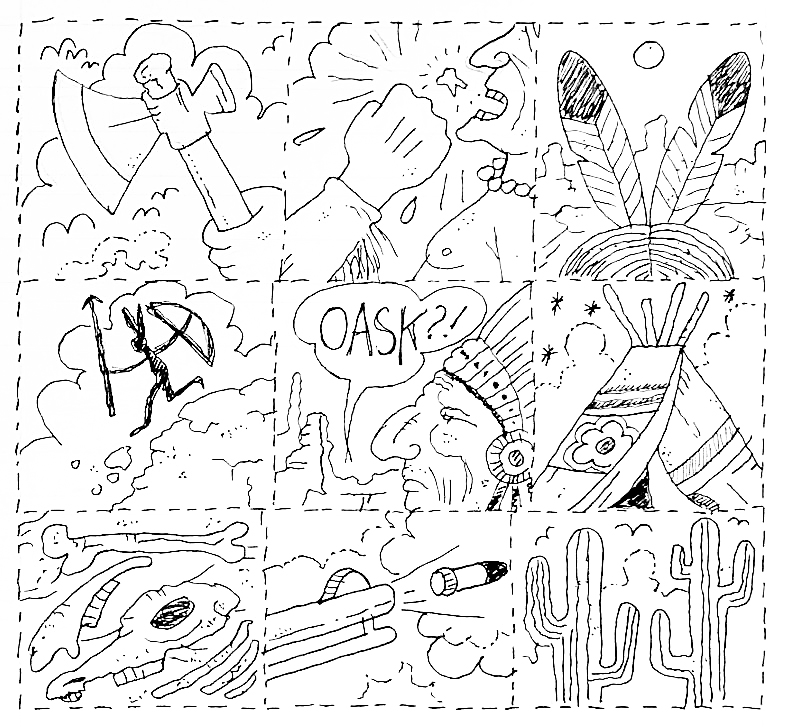
Pablo Echaurren, drawing from the notebook Oask?! Facciamo un giornale anormale [Oask ?! Let’s make an unusual newspaper], ink on paper, 1977. Mart, Archivio del ‘900, Pablo Echaurren’s documents.
Mariarosa Mariech
Mariarosa Mariech holds a degree in Literature, with a focus on Modern Studies; she has worked at the Provincial Superintendence managing historic book collections; since 2005, she has been working at the Mart Library, which she has been coordinating as the head since 2012. Over time, she has overseen various Civil Service projects, while also hosting interns, volunteers, and external collaborators.